
What’s going on at Aave?
A recap of the drama.

Happy Monday! Let’s recap the most important crypto news from last week.
On today’s menu:
A recap of the Aave drama
Tether is building a search engine
Today’s Big Stories:
The Aave situation – a roundup
The biggest lending protocol ever just hit a record $1 trillion in all-time lending volume with $26 billion in TVL.
By every protocol metric, it’s a monster. But by governance metrics, it’s been on fire. Not the good kind.
Before we give you the lowdown, a couple things you need to know:
One side of this conflict is Aave Labs. That’s the team led by founder Stani Kulechov and built Aave.
The other side: the DAO, or the elected leaders of the community that governs Aave.
Here’s the timeline of how it unraveled:
December 2025 — A DAO delegate discovered something ugly. After Aave Labs integrated CowSwap for swaps on its platform, roughly $200K per week in fees that previously went to the DAO were quietly being redirected to a private Aave Labs wallet instead.
Marc Zeller, head of the Aave Chan Initiative, called it “stealth privatization.” Kulechov said the fees were outside DAO jurisdiction. The community exploded.
January to February 2026 — The fight escalated into a full governance war over who owns Aave: the Labs that built it or the DAO that runs it. BGD Labs — the external technical team that built and maintained V3 for four years — announced they’d be leaving, citing centralization concerns and Aave Labs aggressively pushing V4 while artificially constraining V3 improvements. Meanwhile, Kulechov bought $10M of AAVE tokens, which critics immediately flagged as a move to boost voting power ahead of key governance proposals.
February to March 2026 — A compromise proposal called “Aave Will Win“ passed with just 52.58% approval — but ACI’s Zeller immediately challenged the result, claiming Lab-linked addresses tipped the vote. The deal: Aave Labs would route 100% of product revenue to the DAO in exchange for $42.5M in stablecoins and 75,000 AAVE tokens. Critics pointed out this effectively rewarded the party who’d been taking unauthorized fees with a bigger payout.
April 6, 2026 — The final gut punch. Chaos Labs, Aave’s primary risk manager since 2022, walked out. They cited a “fundamental misalignment” with Aave’s direction, the rising complexity of V4, and the fact that even with the proposed $5M budget they were operating at a structural loss. In four months, Aave had lost its main developer (BGD Labs), its largest governance group (ACI), and its risk manager (Chaos Labs).
April 12, 2026 — The vote is held. The proposal is passed with 75% voting yes. Kulechov calls this “the most important proposal in Aave’s history.”
The final deal:
100% of revenue from every Aave-branded product (Aave App, Aave Pro, Aave Card, Aave Kit, Horizon) now flows directly to the DAO treasury, permanently.
But, in exchange, Aave Labs receives $25M and 75,000 AAVE tokens (worth ~$7M).
So the outcome of all this chaos?
AAVE holders get more clarity and value to their token, but the trust between the DAO and its builders – which are supposed to be aligned – is now broken, and people are cautious about what will happen next.
Google’s next competitor is… Tether?
Paolo Ardoino just casually dropped that Tether’s engineers are building a decentralized search engine called Hypersearch.
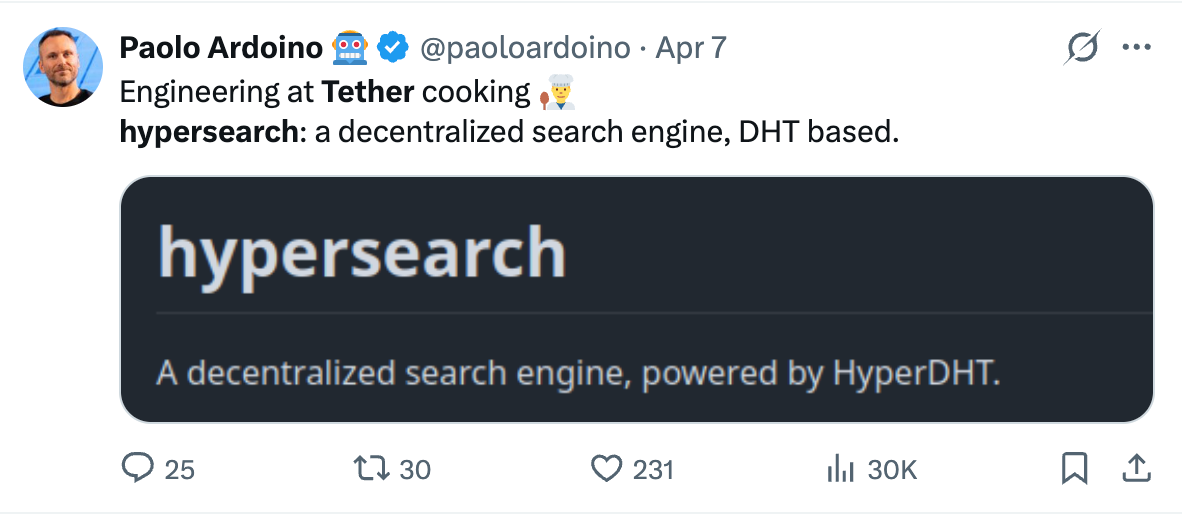
Built on a distributed hash table (DHT) architecture — specifically HyperDHT — it routes search queries directly through a peer-to-peer network with no centralized servers, no surveillance, and no single point of failure.
Think Google, but no Google snooping around.
On the surface this sounds random. But zoom out and it’s the same play Tether has run every time. USDT never chased JPMorgan customers.
It went to the people left behind by the traditional financial system — the 536M users in Argentina, Nigeria, Vietnam, and Haiti who needed a dollar but couldn’t access one.
Hypersearch is the same logic applied to information. Billions of people live under governments that censor search results.
A peer-to-peer search engine with no server to block, no company to pressure, and no algorithm to manipulate is a tool for exactly those people.
Here’s the strategic thread that ties it all together. Ardoino believes that within 3 to 5 years, today’s most powerful smartphones will be commonplace across Africa and South America — enabling up to 80% of AI use cases. “So USDT will empower the biggest decentralized AI platform in the world.”
Tether isn’t building products randomly. They’re building a stack: decentralized AI (QVAC), decentralized messaging (Keet), and now decentralized search (Hypersearch). Every product sends more people into the Tether ecosystem. And every person in the ecosystem is a potential USDT user.
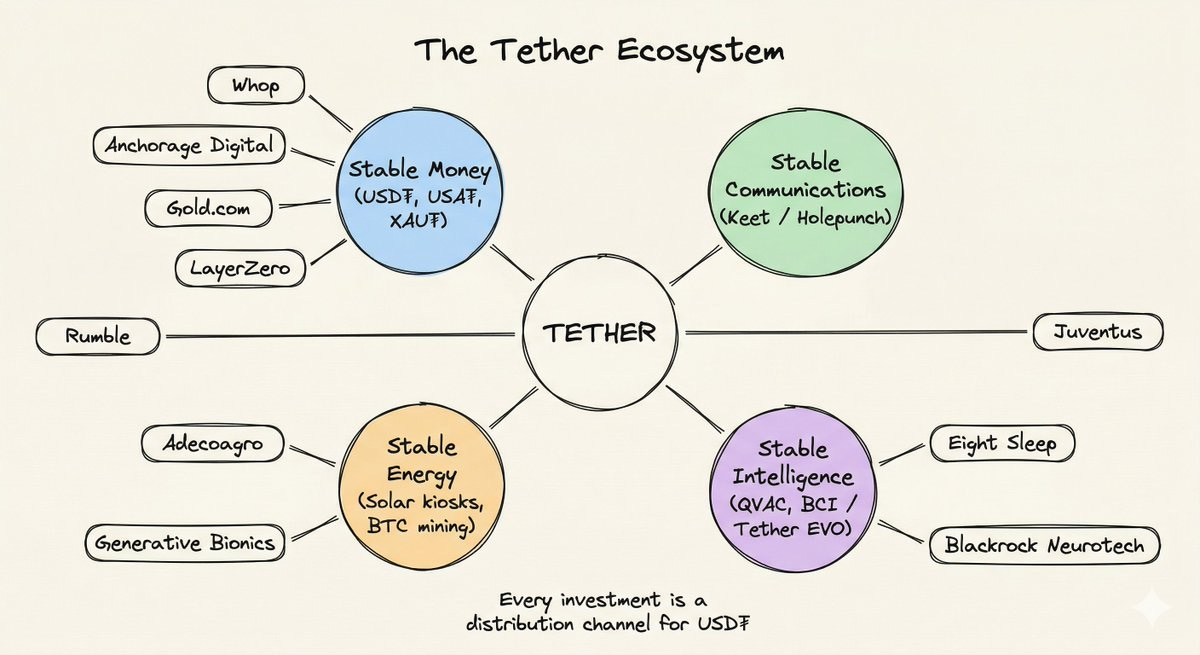
It’s the most ambitious distribution strategy in crypto. You don’t convince people to use your stablecoin by buying billboards. You build the infrastructure they depend on daily — search, communication, AI — and make USDT the native currency that runs underneath all of it.
Whenever you look at Tether news, I encourage you to ask yourself: “How is this helping them distribute USDT?”
USDT is the perfect product: It’s scalable, has 100% net interest margins, super-profitable, and so simple that boomers and the uneducated can understand what it does and how to get it.
Anything Tether does, they’re doing to give people the chance to mint USDT, which gives them more reserves to invest with. And that results in more profits.
thanks for this, the tether stack play is the part worth paying attention to.
Brother, great style and topics. Keep going!